Tag Archives: Technology/Internet

CSS sprites. Go beyond the limits with base64!

Why should I optimize CSS?

In fact how and why should I optimize CSS is the right question. Actually CSS is simply one ore more files loaded from the server to the client, usually a browser, with CSS specific rules that must be applied by the browser to the web page you’re seeing. That’s in general. Of course there are exceptions when CSS can be inline or added directly to the HTML tags, which is bad practice because thus the HTML markup becomes larger and even worse the browser cannot cache it and than load it quickly. In fact that’s why usually the CSS of a web page is put in one single file. Primary because that makes only one request to the server and in second hand because it can be cached by the browser.

Just because the nature of the CSS is that firstly it’s loaded and than executed one of the primary techniques of optimizing it is to make it smaller and therefore load faster. There are several methods of doing so. Enabling GZIP support of the web server and minifying the file are the most common ones. But one of the tricks you cannot optimizing just for second is using the so called CSS sprites.

CSS sprites

What are these? To answer this question I’ll simply try to give you an example. Let’s assume there are three CSS classes each one with its own background image. This makes four requests to the server. One for the CSS file and one per every background image. But what we’d like to achieve is to make less requests as we can. Than one of the things we can do is to make one single image and to change only the background-position CSS property to position it on the right place and to make it appear correctly.

Be careful! When you join all of the images into one single CSS sprite you may add one class with that background-image and every other class with only background-position property. Than every DOM element with that background must have both class names. Only than you can be sure the server will make two requests. One for the CSS file and one for the sprite.

base64 to encode images

In other hand most of the web projects are pretty big, and unfortunately it’s too difficult to make only one single sprite just because it’s too difficult to manage it after the project has become very large. That’s why mostly in the practice there are several sprites for the main components. But the problem is that again there are more HTTP requests.

Is there any way to make only one request?

Yes there is. Simply by converting your CSS sprite into a base64 encoded image. In breve base64 is an encoding where you can practically make any data into a string. Thus the image can be represented by a string containing the same information as the image. Hopefully most of the browser, except of course MSIE, does read the so called data urls, or:

<img src="data:image/png;base64,..... " />

and that’s enough to get started with base64 and the single request. The sprite has become a string!

CSS and base64

The natural question is now how to merge all this? You now have one CSS file with one or more sprites. Than you can convert them into a base64 encoded strings and put them all into the CSS.

There is a problem, of course, what happens with MSIE. As I said before MSIE doesn’t read base64 encoded images. Hopefully there is a solution described very well by Stoyan Stefanov in his blog post here.

Finally …

now there is only one request and everything works pretty fine. This technique can be really helpful to someone who’s trying to optimize the CSS performance to the limits.
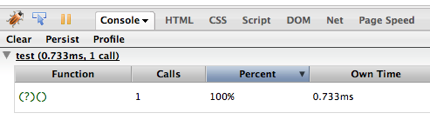
Firebug’s console.profile vs console.time

Firebug’s console.time!

This post is directly related to the previous post where I explain how to use the Firebug’s console object and in that case its time method. That is really powerful and gives the opportunity to track the performance of a sample JavaScript chunk of code. What it does not do is to give you a more detailed profile of that particular JS code.

That’s because the console’s profile method works on functions and if you’d like to profile a loop it will give you there’s nothing to be profiled. One workaround to that is to use closures.

JavaScript closures

A JavaScript closure is to make an anonymous function and to put the code in it, like so:

(function() {
 for (var i = 100000; i--; ) {
  var a = new Array();
 }
})();

Firebug’s console.profile()

That code can be than wrapped with both console.profile() and console.profileEnd() in something like:

console.profile('my profile');
(function() {
 for ( var i = 100000; i--; ) {
  var a  = new Array();
 }
})();
console.profileEnd('my profile');

That will give a more precise measurement like that one shown on the picture bellow:

firebug console.profile

Profiling JavaScript with Firebug. console.profile() & console.time()!

Firebug and the console object

Although my impression is that most of the web developers use Firefox and most of them are using Firebug, I’m not sure that they use the full potential of this brilliant software.

Firebug’s console view

Firebug is a very powerful tool helping those like me doing his job. But what’s behind the mostly used Firebug’s tools and what’s in the API.

console.log()

For a typical JavaScript programmer the console.log() function is one of his best friends. It can dump useful information in the console tab of the Firebug making everything quite clear. But have you ever asked yourself how to improve your code, how to measure its performance against some constructions.

Performance of JavaScript

I’m sure many of us have read enough articles out in the web about JS performance. Nowadays when the web apps become bigger and bigger, this topic is rising from the bottom of the interesting topics pool. Now everybody’s concerned about it’s app performance and speed.

You’ve probably heart about some basic advices. What to use, what not to use. In a short example I’ll mention only that everybody knows that .appendChild is far slower than the innerHTML. But why is that? How can be sure it’s true.

As I wrote recently you should instantiate your new arrays in javascript with the following construction:

var a = [];

instead of:

var a = new Array();

but as I’ll write here that’s not always true.

console.profile()

One of the useful methods of the Firebug’s console object is the profile() method. It gives you the power to measure timing and performance of any JS function. As described in the Firebug’s web page:

The high-fi approach is to use the JavaScript profiler. Just call console.profile() before the code you want to measure, and then console.profileEnd() afterwards. Firebug will log a detailed report about how much time was spent in every function call in between.

With the simple construction like:

<html>
<body>
<script>
    myFunc = function() {
        var a = [];
    }				

   console.profile();
   myFunc();
   console.profileEnd();
</script>
</body>
</html>

Firebug’s profile output

The simple problem is that thus you cannot just measure some code that’s not a function. This will result in empty profile output in the console’s view:

But hopefully there comes the other method of the console object.

console.time()

It gives anything you’d like to know even if it’s not closed into a function.

Note: remember that both profile and time methods goes with their related profileEnd and timeEnd methods. You’re supposed to enclose the chunk of code you measure with that to be sure that the Firebug’s console will stop the profilers on time.

Now you can simply ask the profiler: what is faster?

Speed up the JavaScript. It can change dramatically the user experience.

JavaScript in a modern web application

If someone asks you what is the javascript in modern web developer, probably you should answer it’s almost the half of the traffic of your site and it’s almost everything when dealing with user experience.

Today’s big web apps are useless without it AJAX/JS part. Think about Facebook, Google products, Twitter, Yahoo!, Youtube.

Actually they made this a standart. The times when you used to use JavaScript as a helper language just to figure out how a drop down menu will work are far way in the past. Now JavaScript is everything in a rich web sites. With no JS they will be no rich at all! Then it comes the question how to improve sites with lots of javascript. Actually one of the main problems in the web now is that JavaScript is blocking content.

Blocked by the JavaScript

What that means at all is that until the browser receives and parses the JavaScript file/s it doesn’t process anything else, it even doesn’t load any other resources. Now you can imagine how big the problem is. When it comes to large files more than 100K the user experience will be very bad!

Optimize the web? What about optimizing JavaScript!

If the problem is so big as I described above why should we doubt about where to start with the optimization process? But of course with the JavaScript and the natural question that rises is how this can be optimized at all?

Three steps

Like me, many of you may heart of some techniques that improve javascript performance. Here are some I was able to select as important:

1. minify/compress

That’s rule number one. If everything that is a JavaScript file is processed once it arrives to the client than make it smaller and make it go faster trough the wire. Actually one technique to speed up things more is to concatenated all the files you have into one single big file. Although this will not spend you some space will reduce the HTTP requests and therefore speed up the loading process. Good tools that you can use to minify javascript files are the Yahoo’s YUI Compressor, that beside that compresses CSS and Google Closure Compiler. Both are extremely useful and by the last measurements the Google’s Compiler is even better, but it’s up to you to decide which one to pick up.

2 .write fast and smart code

You can minify everything that’s JavaScript and the code may remain slow. But why is that? That’s because the JavaScript is written in a bad way. You know there are many resources in the web describing what is a bad and what is a good practice when writing JS. Even more you can measure it by yourself if you’d like to use the Firebug’s profiler. That’s a good start to avoid bad practices.

3. improve loading – lazy loading

That’s a bit more complicated. If there’s a really big javascript file after compressing and concatenating all the JS functionality remains big. How to avoid that? Simply let’s the user to see the most important functionality and than load the entire app. Some good tutorials about lazy loading again can be found online. Don’t hesitate to search about.

Beside this really basic advices I’ll continue to write in my blog about specific techniques how to improve the JavaScript as this is one of the most interesting parts of web development by me.

Optimizing CSS. Five simple steps!

In the spirit of the optimization wave this post is about CSS optimization. There are some simple rules that you can apply. I’m pretty sure most of us have already been familiar with that list, but you never know.

1. Minify

As the JavaScript the CSS also can be minified. This only strips every character that makes the traffic bigger. As you know a well constructed and pretty looking CSS file consists of many new lines, tabs and spaces. Almost every software minifies the CSS by simply removing them. Some of the programs go even further with replacements of different parts of the code considered to be not efficient.

2. Use effective selectors

Some CSS selectors aren’t really efficient. Imagine something like: body div a just to describe only one specific link. That’s really bad. Better practice is to replace that line with something like a.my-class and to replace the a tag into the DOM with that class name. That will be far more effective. Actually if you’re wondering how to find such bad selectors, there’s a tool by Google called Page Speed that’s a Firebug’s plugin and can extract a list of all bad selectors.

3. Inheritance

CSS is really powerful when dealing with inheritance. That’s something that is not some clear but however really powerful. This technique is in the basics of the next rule.

4. Sprites

I’ve written already about CSS sprites. This is nothing new, but be careful when making a new site’s layout. CSS sprites spend you HTTP request and that’s rule number one according to Steve Souders’ list of optimization.

5. Separate logic

Sometimes developers put the site logic in only one file that become to large. Be aware of that. This is hard to maintain and you load things that you don’t need.

That’s a really short list of what you can do with CSS to speed the site up. I hope that can help someone when dealing with cascading style sheets.