Computer Algorithms: Data Compression with Bitmaps

Overview

In my previous post we saw how to compress data consisting of very long runs of repeating elements. This type of compression is known as “run-length encoding” and can be very handy when transferring data with no loss. The problem is that the data must follow a specific format. Thus the string “aaaaaaaabbbbbbbb” can be compressed as “a8b8”. Now a string with length 16 can be compressed as a string with length 4, which is 25% of its initial length without loosing any information. There will be a problem in case the characters (elements) were dispersed in a different way. What would happen if the characters are the same, but they don’t form long runs? What if the string was “abababababababab”? The same length, the same characters, but we cannot use run-length encoding! Indeed using this algorithm we’ll get at best the same string.

In this case, however, we can see another fact. The string consists of too many repeating elements, although not arranged one after another. We can compress this string with a bitmap. This means that we can save the positions of the occurrences of a given element with a sequence of bits, which can be easily converted into a decimal value. In the example above the string “abababababababab” can be compressed as “1010101010101010”, which is 43690 in decimals, and even better AAAA in hexadecimal. Thus the long string can be compressed. When decompressing (decoding) the message we can convert again from decimal/hexadecimal into binary and match the occurrences of the characters. Well, the example above is too simple, but let’s say only one of the characters is repeating and the rest of the string consists of different characters like this: “abacadaeafagahai”. Then we can use bitmap only for the character “a” – “1010101010101010” and compress it as “AAAA bcdefghi”. As you can see all the example strings are exactly 16 characters and that is a limitation. To use bitmaps with variable length of the data is a bit tricky and it is not always easy (if possible) to decompress it.

Bitmap Compression
Basically bitmap compression saves the positions of an element that is repeated very often in the message!

Continue reading Computer Algorithms: Data Compression with Bitmaps
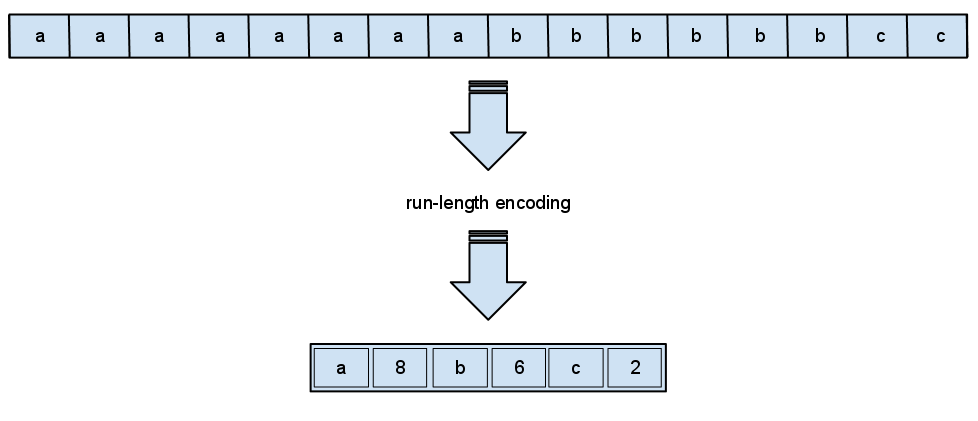
Computer Algorithms: Data Compression with Run-length Encoding

Introduction

No matter how fast today’s computers and networks are, the users will constantly need faster and faster services. To reduce the volume of the transferred data we usually use some sort of compression. That is why this computer sciences area will be always interesting to research and develop.

There are many data compression algorithms, some of them lossless, others lossy, but their main goal aways will be to spare storage space and traffic. These algorithms are very useful when talking about data transfer between two distant places. Perhaps the best example is the transfer between a web server and a browser.

In the last few years a lot of research has been done on compressing files, executed on the client side. Such files are javascript, css, htmls and images. In fact servers and clients already have some techniques to compress data, like using GZIP for instance, that can dramatically decrease the transfer. In the other hand there are lots of tools and tricks in order to decrease the size of the data.

Actually when a file is executed by the client’s virtual machine, it doesn’t matter how “beautifully” it is formatted from a programmer’s point of view. Thus the spaces, tabs and the new lines don’t bring any significant information for the environment. That is why such compressing tools like YUI Compressor, Google Closure Compiler, etc. remove those symbols. Well, they can achieve even more in order to improve the compression rate. In this post I won’t cover this, but this shows how important data compression algorithms are.

It would be great if we could just compress data with some tool. Unfortunately this is not the case and usually the compression rate depends on the data itself. It is obvious that the choice of data compression algorithm depends mainly on the data and first of all we must explore the data.

Here I’ll cover one very simple lossless data compression algorithm called “run-length encoding” that can be very useful in some cases.

Run-length Encoding

Overview

This algorithm consists of replacing large sequences of repeating data with only one item of this data followed by a counter showing how many times this item is repeated. To become clearer let’s see a string example.

aaaaaaaaaabbbaxxxxyyyzyx

This string’s length is 24 and as we can see there are lots of repetitions. Using the run-length algorithm, we replace any run with shorter string followed by a counter.

a10b3a1x4y3z1y1x1

The length of this string is 17, which is approximately 70% of the initial length. Continue reading Computer Algorithms: Data Compression with Run-length Encoding

PHP Performance: Bitwise Division

Recently I wrote about binary search and then I said that in some languages, like PHP, bitwise division by two is not faster than the typical “/” operator. However I decided to make some experiments and here are the results.

Important Note

It’s very important to say that the following results are dependant from the machine and the environment!

Source Code

Here’s the PHP source code.

function divide($n = 1) 
{
	$a = microtime(true);
	for ($i = 0; $i < $n; $i++) {
		300/2;
	}
	echo microtime(true) - $a;
}
 
divide(100);
//divide(1000);
//divide(10000);
//divide(100000);
//divide(1000000);
//divide(10000000);

Continue reading PHP Performance: Bitwise Division

Computer Algorithms: Interpolation Search

Overview

I wrote about binary search in my previous post, which is indeed one very fast searching algorithm, but in some cases we can achieve even faster results. Such an algorithm is the “interpolation search” – perhaps the most interesting of all searching algorithms. However we shouldn’t forget that the data must follow some limitations. In first place the array must be sorted. Also we must know the bounds of the interval.

Why is that? Well, this algorithm tries to follow the way we search a name in a phone book, or a word in the dictionary. We, humans, know in advance that in case the name we’re searching starts with a “B”, like “Bond” for instance, we should start searching near the beginning of the phone book. Thus if we’re searching the word “algorithm” in the dictionary, you know that it should be placed somewhere at the beginning. This is because we know the order of the letters, we know the interval (a-z), and somehow we intuitively know that the words are dispersed equally. These facts are enough to realize that the binary search can be a bad choice. Indeed the binary search algorithm divides the list in two equal sub-lists, which is useless if we know in advance that the searched item is somewhere in the beginning or the end of the list. Yes, we can use also jump search if the item is at the beginning, but not if it is at the end, in that case this algorithm is not so effective.

So the interpolation search is based on some simple facts. The binary search divides the interval on two equal sub-lists, as shown on the image bellow.

Binary search basic approach
The binary search algorithm divides the list in two equal sub-lists!

What will happen if we don’t use the constant ½, but another more accurate constant “C”, that can lead us closer to the searched item.

Interpolation search
The interpolation search algorithm tries to improve the binary search!

Continue reading Computer Algorithms: Interpolation Search

Computer Algorithms: Binary Search

Overview

The binary search is perhaps the most famous and best suitable search algorithm for sorted arrays. Indeed when the array is sorted it is useless to check every single item against the desired value. Of course a better approach is to jump straight to the middle item of the array and if the item’s value is greater than the desired one, we can jump back again to the middle of the interval. Thus the new interval is half the size of the initial one.

Binary search basic implementation
Basic implementation of binary search

If the searched value is greater than the one placed at the middle of the sorted array, we can jump forward. Again on each step the considered list is getting half as long as the list on the previous step, as shown on the image bellow.

Binary search - basic implementation

Implementation

Here’s a sample implementation of this algorithm on PHP. Obviously the nature of this approach is guiding us to a recursive implementation, but as we know, sometimes recursion can be dangerous. That’s why here we can see either the recursive and iterative solution. Continue reading Computer Algorithms: Binary Search